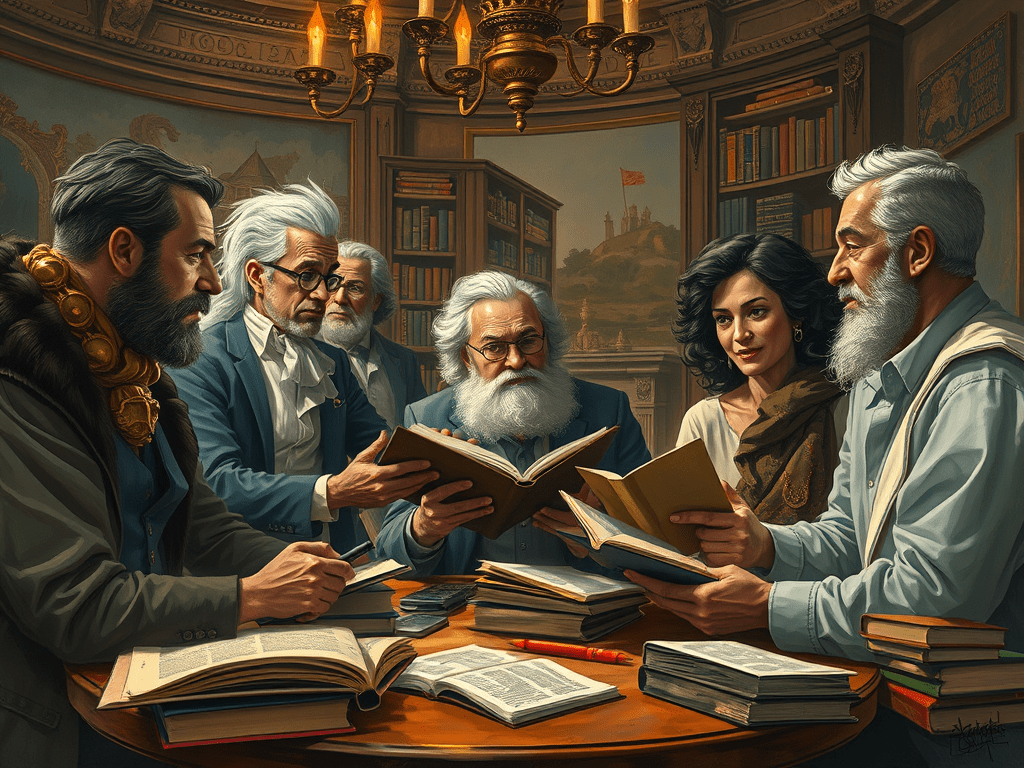
The 20th century was a period of dramatic cultural, political, and technological change, and literature reflected this upheaval. Writers broke from tradition, experimented with form and language, and questioned the very foundations of human existence. From the fragmented narratives of Modernism to the philosophical dilemmas of Existentialism, the warnings of dystopian fiction, the playful irreverence of Postmodernism, and the rise of literary theory, this era reshaped storytelling and critical thought.
Modernist Literature: Experimentation and the Inner Mind
Modernist literature, emerging in the early 20th century, rejected conventional storytelling in favor of stream of consciousness, non-linear narratives, and deep psychological exploration. Influenced by World War I, rapid industrialization, and shifting cultural norms, Modernist writers sought to capture the fractured, uncertain nature of modern life.
James Joyce’s Ulysses (1922) is a landmark of Modernist experimentation, using interior monologue, shifting perspectives, and linguistic innovation to depict a single day in the life of Leopold Bloom. Similarly, Virginia Woolf’s Mrs. Dalloway (1925) delves into the thoughts and emotions of its characters in a flowing, introspective style, challenging traditional plot structures.
T.S. Eliot’s poetry, particularly The Waste Land (1922), reflects the disillusionment of the post-war generation. With its fragmented structure and allusions to multiple literary and cultural traditions, the poem captures a world struggling to find meaning in the aftermath of destruction.
Modernist literature sought to represent human consciousness in all its complexity, rejecting absolute truths and embracing ambiguity and subjectivity.
Existentialist Literature: Freedom, Angst, and Absurdity
As the world faced totalitarianism, war, and existential crises, writers turned to philosophy to make sense of human existence. Existentialist literature, deeply influenced by philosophers such as Jean-Paul Sartre and Martin Heidegger, grappled with themes of freedom, alienation, and the search for meaning in an indifferent universe.
Albert Camus’ The Stranger (1942) epitomizes existentialist thought. Its protagonist, Meursault, reacts with indifference to life’s events, embodying Camus’ idea of the absurd—the conflict between humanity’s search for meaning and the universe’s silence. Sartre’s Nausea (1938) explores a similar existential dread, as its narrator experiences a growing detachment from reality and a realization of life’s lack of inherent meaning.
Existentialist literature forced readers to confront uncomfortable truths about autonomy, morality, and the nature of existence, influencing philosophy and literature for generations.
Dystopian Fiction: Warnings of the Future
The 20th century, marked by totalitarian regimes, surveillance states, and rapid technological advancements, gave rise to dystopian fiction—novels that warned of oppressive futures shaped by political control, dehumanization, and societal collapse.
George Orwell’s 1984 (1949) remains one of the most chilling visions of a surveillance state, where “Big Brother” monitors every aspect of life, history is rewritten, and independent thought is crushed. Aldous Huxley’s Brave New World (1932) presents a different but equally terrifying future, where humanity is controlled through pleasure, consumerism, and genetic engineering rather than force.
Other dystopian works, such as Ray Bradbury’s Fahrenheit 451 (1953) and Margaret Atwood’s The Handmaid’s Tale (1985), continued this tradition, exploring censorship, state control, and the subjugation of individuals.
Dystopian fiction serves as both a critique of contemporary society and a warning about the dangers of unchecked political and technological power.
Postmodern Literature: Playfulness, Parody, and Uncertainty
In the latter half of the 20th century, literature took another radical turn with the rise of Postmodernism. Rejecting Modernist seriousness, Postmodern writers embraced playfulness, metafiction, irony, and fragmentation, often questioning the nature of reality itself.
Jorge Luis Borges, one of the earliest Postmodern writers, blurred the lines between fiction and philosophy in stories like The Library of Babel and Tlön, Uqbar, Orbis Tertius, which explore infinite knowledge, imagined realities, and the instability of truth.
Thomas Pynchon’s Gravity’s Rainbow (1973) embodies Postmodernism’s chaotic style, weaving together conspiracy theories, historical events, and absurd humor in a sprawling, non-linear narrative. Other Postmodern authors, such as Kurt Vonnegut (Slaughterhouse-Five) and Don DeLillo (White Noise), used satire and self-awareness to critique modern society, media, and historical narratives.
Postmodern literature challenges readers to question truth, authorship, and meaning itself, reflecting a world where certainty has collapsed.
Literary Criticism & Theory: Deconstructing Meaning
Alongside literary innovation, the 20th century saw the rise of literary theory, as critics and philosophers developed new ways of interpreting texts.
Sigmund Freud’s psychoanalytic theories, particularly in The Interpretation of Dreams (1899), influenced literature by emphasizing the unconscious, symbolism, and repressed desires. Many Modernist and Postmodernist writers drew from Freudian concepts in their explorations of character psychology.
Jacques Derrida’s deconstructionist approach, introduced in the 1960s, questioned the stability of language and meaning. His work challenged traditional literary interpretations, arguing that texts contain inherent contradictions and multiple possible readings.
Michel Foucault, a historian and philosopher, examined the relationship between power, knowledge, and discourse. His studies on institutions, surveillance, and social control influenced Postmodern literature and criticism, revealing how narratives shape ideology.
These theorists reshaped the way literature is read and analyzed, moving beyond surface-level interpretation to explore deeper structures of meaning, power, and identity.
Conclusion: The Enduring Influence of 20th-Century Literature
The 20th century was a revolutionary period for literature, filled with innovation, rebellion, and intellectual depth. Modernist writers shattered traditional storytelling, Existentialists questioned the meaning of life, dystopian authors warned of oppressive futures, Postmodernists deconstructed reality, and literary theorists redefined how we understand texts.
These movements continue to shape contemporary literature and thought, challenging readers to engage critically with the world and question their assumptions. In an era of rapid change, the voices of the 20th century still speak with urgency, reminding us that literature is not just a reflection of society—it is a force that shapes it.
 Learn Western Culture