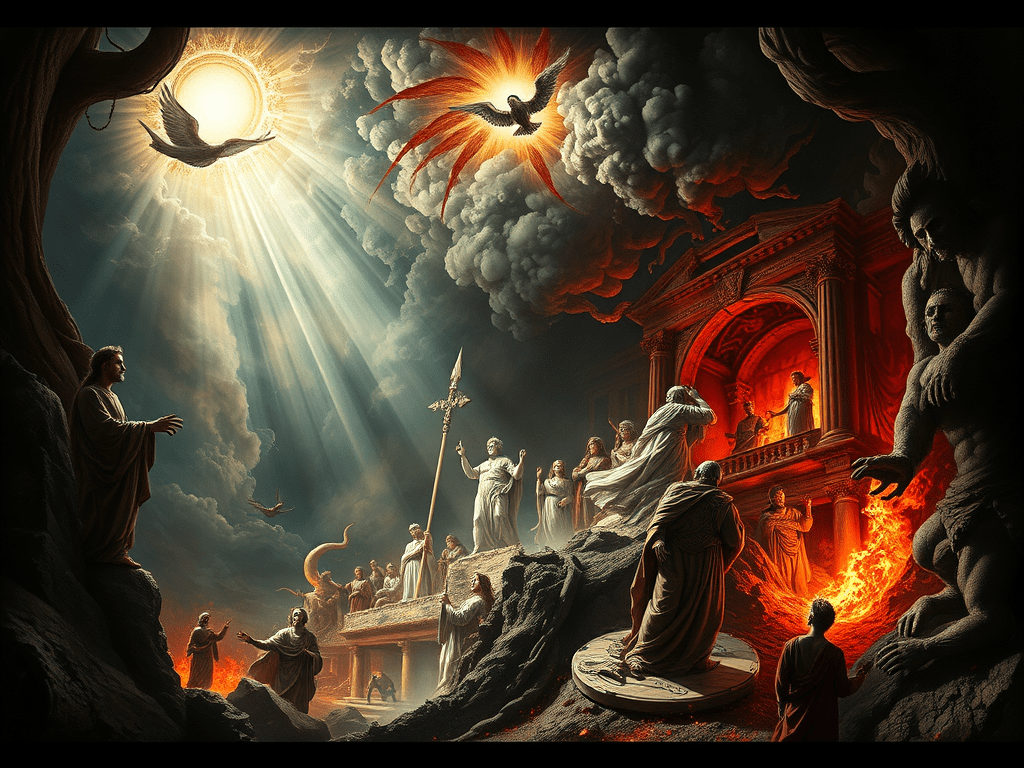
Allegory in Western Culture: Dante’s Divine Comedy and Everyman
Allegory has played a crucial role in shaping Western Civilization, particularly through the Medieval and Early Christian writings that used symbolic storytelling to convey theological and moral truths. Two of the most significant allegorical works, Dante Alighieri’s Divine Comedy and the morality play Everyman, offer profound insights into human nature, salvation, and the spiritual journey. These works continue to influence literature, philosophy, and religious thought in Western Culture.
Dante’s Divine Comedy: A Journey Through the Afterlife
Written in the early 14th century, Dante’s Divine Comedy is one of the greatest allegories in Western Civilization. It is both a theological exploration of the Christian afterlife and a personal reflection on sin, redemption, and divine justice. The epic poem follows Dante as he journeys through Hell (Inferno), Purgatory (Purgatorio), and Heaven (Paradiso), guided first by the Roman poet Virgil and later by Beatrice, who represents divine love and grace.
Dante’s work embodies key elements of Medieval writings by blending Christian theology with classical philosophy, particularly drawing from Aristotle and Augustine. The structured afterlife he presents influenced Christian conceptions of sin, punishment, and divine justice for centuries. Moreover, The Divine Comedy helped shape Western Culture’s literary tradition, inspiring later poets such as Milton and T.S. Eliot.
Everyman: The Universal Christian Allegory
Unlike The Divine Comedy, which is an epic poem, Everyman is a late 15th-century morality play that personifies abstract concepts to teach moral lessons. This Early Christian writing portrays the journey of Everyman, a symbolic character representing all of humanity, as he faces death and must account for his deeds. Along the way, allegorical figures such as Fellowship, Goods, and Knowledge accompany him, only for most of them to abandon him in the end—except for Good Deeds, which remains faithful and ensures his salvation.
Everyman reflects the Medieval worldview by emphasizing the transience of worldly pursuits and the necessity of spiritual preparation for death. It reinforced key aspects of Western Civilization’s religious thought, particularly the importance of personal responsibility, confession, and grace in achieving salvation.
Allegory’s Enduring Impact on Western Civilization
Both The Divine Comedy and Everyman illustrate how allegory served as a powerful tool in Medieval and Early Christian writings. These works provided frameworks for understanding moral and theological concepts, influencing not only religious discourse but also literature, art, and drama in Western Culture. The themes they explore—sin and redemption, divine justice, and the human soul’s journey—remain deeply embedded in Western Civilization’s intellectual and artistic traditions.
Even today, the allegorical techniques of Dante and the morality plays continue to inform storytelling, from literature to film. Their influence on Western Culture is a testament to the enduring power of allegory as a means of conveying profound spiritual and philosophical truths.
 Learn Western Culture
Leave a comment